

It has been eight amazing weeks for DART of Physics . We've loved talking to...
DART of PHYSICS Blog
Tuning in to the Solar Radio
Nov 29 2013
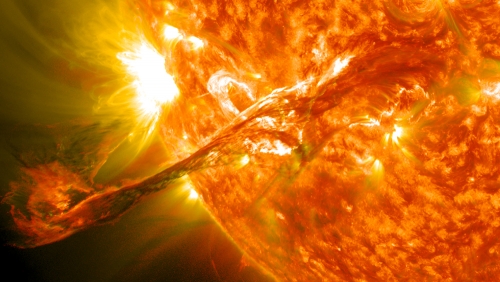
The Sun gives light and heat that make life comfortable here on planet Earth. However, it can have more sinister effects, sometimes unleashing huge eruptions of hot gas, called solar storms, which carry billions of tons of matter travelling at millions of kilometres an hour in Earth’s direction. These storms can be accompanied by solar radio bursts, which can cause damaging effects on many of the technologies that we rely on in our everyday lives.
Despite decades of study, the link between solar storms and solar radio bursts has remained unclear. This lead us to establish a radio... Continue reading
The Top 5 Amazing Things I Love About Physics
Nov 28 2013
1. Heisenberg’s Uncertainty Principle – What’s not to love? Know the position of a quantum particle? Then you can’t accurately know its momentum. Vice versa. Ever.
2. Quantum entanglement - Entangled particles remain connected so that actions performed on one affect the other, even when separated by vast, vast distances. When that was first explained to me it seemed a little like magic, not... Continue reading
DART of Physics, Live in Pearse Street Station!
Nov 27 2013

The crew will be at Pearse Street DART Station on Tuesday 3 rd December, performing different eye-catching demos, showing you that physics is all around us. Each demo will only last 1 or 2 minutes, perfect while you’re waiting for your DART.
Trinity College Dublin Physics students will be taking to the DART all day Tuesday in bright t-shirts. It’s a... Continue reading
The Natural Abundance of Elements
Nov 26 2013
You may know about the different chemical elements and the periodic table , but which elements are the ones that matter? The lovely infographic below which shows the natural abundance of those elements in the universe, inside the Earth, in the Earth's crust, in the oceans, in the atmosphere, and in us!
Bringing Excitement Back Into Science Education
Nov 25 2013

As a teacher, I’m already convinced at how wonderful science and scientific exploration are but the most difficult part of my job is convincing my pupils. One might imagine that convincing young people that science is cool, interesting and fun might be easy but alas, like every teacher, I experience obstacles along the road. The Dart of Physics team have shown us that “ science isn’t about memorising equations and battling proofs ” and that science can be brought alive by tickling your... Continue reading
Why Is The Sky Blue?
Nov 22 2013

It's one of the most basic questions we can ask about the world around us: why is the sky blue?
When light from the Sun reaches Earth, some colors of light are absorbed by particles in the atmosphere, but others are scattered, which means that the photons in question are deflected to a new direction. Other than absorption of light, scattering is the main phenomenon that affects color.
There are a few different types of scattering. Light can be scattered by objects that are a size similar to the wavelength of that light, which is called Mie scattering, and it’s why clouds... Continue reading
- ‹ previous
- 3 of 9
- next ›
Dart of Physics Blog
-
3 years 11 months ago
-
3 years 11 months ago
Quantum physics is odd. Really odd. Particles can be in two places at once, behavior can depend on whether or not...