Is a plasma TV full of tiny suns?
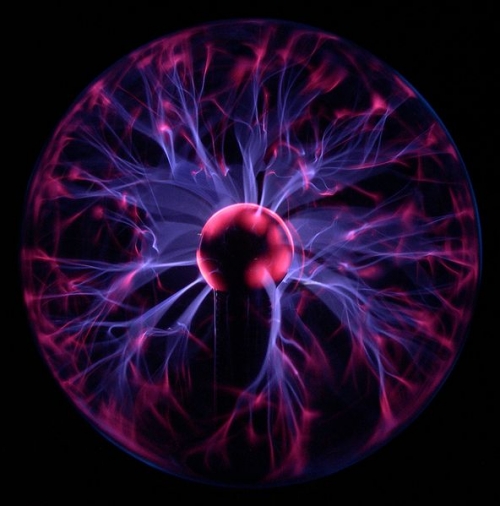
You've probably heard of a plasma display, and may even know that a plasma is a phase of matter, like a solid, liquid, or gas. But what does that mean? What's a plasma and how is it used in displays?
Plasmas are usually considered a state of matter. But whereas order and density distinguish the other states of matter from each other—solids are dense and ordered, liquid are dense and disordered, and gases are less dense and disordered—for plasma there is another factor that is important. Plasmas are disperse and disordered like gases, but they are also ionized. Whereas a non-ionized gas consists of atoms, in an ionized gas the negatively charged electrons have been stripped from the positively charged atomic nuclei and both are moving freely through the gas. The electrons and nuclei are both called ions, to indicate that they carry a charge . Keeping the ions separated takes a lot of energy, so plasma temperatures are very high compared to what we're used to in our everyday lives. The Sun is made up of plasma, which should give you an idea how hot some plasmas can be!
Plasmas may sound weird, but they're the most common phase of matter in the universe, because of ist prevalence in stars and the space between them. Well, the most phase of luminous matter; there's also dark matter , which seems to make up more total mass than the matter we can see, but its phase and nature are still unknown. There are also lots of examples of plasmas here on Earth, such as lightning bolts, the northern lights, and the neon that lights up a neon sign. You may have noticed that these are all light-emitting phenomena; the high energy of the ions means that they have many lower energy states available to jump to, and those energy level changes often involve emitting a photon to produce visible light.
So how can plasma be controlled to make a display? Illumination comes from tiny pockets of gas that can be excited into a plasma by applying an electrical current, and each pixel is defined by a separate plasma cell. Because of the ions in the plasma, it's very sensitive to electric fields, and you can actually contain the pocket of plasma just using an electrical field. For monochrome displays, the gas can be something like neon which emits light that we can see. But to create multiple colors of light, various phosphors are painted in front of the plasma cells. The phosphors absorb the light emitted by the plasma and emit their own light in a variety of colors. So while a plasma tv can't power a planet or maintain nuclear fusion, it is illuminated using matter that's in the same phase as the Sun!
This post is based on content that originally appeared at Let's Talk About Science . Title image via Wikipedia .

